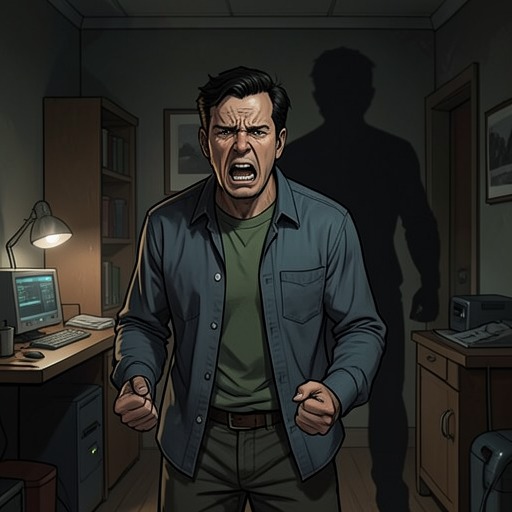
Corey Bryant's encounter with Barlow
'Salem's Lot: A NovelCorey Bryant's encounter with Barlow is a decisive recruitment and conversion scene: a traumatized man trying to flee Jerusalem’s Lot is stopped, psychologically disarmed, and absorbed into Barlow’s expanding supernatural order. The encounter turns Corey’s private humiliation into a channel for vampiric violence and shows how Barlow conquers through sympathy, theatrical charm, and the promise that resentment can become power.
Causes and Setting
Corey reaches Deep Cut Road after the collapse of his ordinary life. He is stumbling toward the phone truck he left there, with bloodshot, glassy eyes, a bump on the back of his head from fainting, and boots dragging along the shoulder. The immediate cause of his flight is Reggie Sawyer’s violence and expulsion: Reggie has discovered Corey’s relationship with Bonnie Sawyer, forced him out through the kitchen door, and ordered him to take the bus from Spencer’s to Lewiston and then Boston. Reggie’s threat is explicit, but he also frames the departure as Corey’s only chance to escape before shame and anger harden into a renewed sense of manhood.
Corey tries to convert the night into a logistical problem. He imagines going south from Boston, wiring for the little over a thousand dollars in his bank account, finding work, and spending years forgetting the gun barrel, the stench of his own fear, and the bodily humiliation he has just endured. This imagined future is not recovery so much as erasure. He is attempting to leave the town before he can think clearly about what has happened, and that mental vacancy makes him vulnerable to the figure waiting in the darkness.
The Encounter on Deep Cut Road
Barlow announces his presence with a calm greeting, calling Corey by name before Corey can see him clearly. The stranger first appears as a more solid shadow beside the stone wall bordering Carl Smith’s back pasture; only in the faint light does Corey make out a middle-aged man with a black mustache and deep, bright eyes. Barlow immediately claims knowledge of Corey’s condition, telling him that he has been ill used. The statement gives Corey recognition at the exact moment when his social identity has been shattered by Reggie’s contempt and violence.
When Corey demands to know who he is, Barlow treats the demand for a name as an absurd American habit. He introduces himself as Barlow only after mocking the way names are used to sell automobiles, restaurants, and television programs. His laughter is rich, startling, and apparently generous. Corey feels his own smile return and finds his troubles becoming distant beside the stranger’s derisive good humor. The scene therefore presents seduction as an alteration of attention: Barlow does not begin by threatening Corey, but by making humiliation seem temporarily insignificant.
Barlow also makes himself culturally and geographically indeterminate. He says that he is from many lands, then reverses Corey’s assumption that the foreigner is the outsider by declaring that the town seems full of foreigners to him. The joke produces another burst of laughter, and Corey joins it with delayed hysteria. Barlow’s cosmopolitan pose enlarges him beyond the town’s narrow social world while simultaneously making the town itself appear provincial and strange. He can stand outside local conventions while speaking directly to Corey’s wounded sense of belonging.
Recruitment Through Resentment
Barlow’s central method is to turn Corey’s grievance into a moral and political accusation. He praises the people who have not severed themselves from the earth behind concrete and cement, describing their hands as plunged into the waters of life and their labor as having ripped life from the soil. Corey agrees, accepting Barlow’s rhetoric before fully understanding its implications. The speech gives natural dignity to a man who has just been treated as disposable, while directing his anger toward a wider class of people imagined as comfortable, protected, or exploitative.
Barlow then addresses Corey with intimate approval, calling him a good and strong boy and placing a hand on his shoulder. The gesture combines paternal reassurance with possession. Corey’s first response is to reject the idea of leaving the supposedly perfect town, but fear begins to return even as he tells himself that fear must be unimportant because Barlow will permit no harm to come to him. The promise of protection is thus inseparable from surrender: Corey is reassured by the very figure who is taking control of his future.
The decisive statement is that Corey shall never leave. Barlow presents permanent confinement as permanent belonging, closing the route of escape while disguising the closure as acceptance. He further promises Corey vengeance against those who fill themselves while others remain wanting. The appeal is carefully fitted to Corey’s condition. Reggie has stripped him of dignity; Barlow offers dignity in the form of retaliation. Corey’s conversion is therefore prepared through language before it is completed through supernatural force: rage is given a target, and victimhood is transformed into service.
Conversion and Consequences
Corey trembles and becomes rooted to the spot as Barlow inclines his head toward him. The movement is restrained rather than spectacular, but it marks the transfer of authority. Corey sinks into what the narration presents as a great forgetful river of time, whose waters are red. Forgetfulness is the immediate psychological consequence, and the red river joins temporal absorption to blood. Corey does not simply choose to stay; his capacity to remember, judge, and continue his planned flight is overwhelmed.
The encounter consequently becomes Corey Bryant’s conversion by Barlow and his recruitment into the vampire colony. It removes him from the human network that might have carried him out of town and places him within the expanding occupation of Jerusalem’s Lot. His resentment survives, but no longer as an independent human response. Barlow appropriates it, turning the grievance against the town’s unequal social order into fuel for the supernatural order that Barlow himself commands.
The later depiction of Barlow’s broader strategy clarifies the scene’s significance. Barlow presents himself as an ancient and calculating opponent of religious goodness, one who studies adversaries like a chess player and regards himself as crafty because he understands both evil and the forms of goodness opposed to it. Corey’s encounter is the local, intimate version of that strategy. Instead of confronting a prepared enemy, Barlow finds a wounded man alone at night, offers recognition, and makes domination feel like rescue.
Narrative Significance
Corey’s encounter exposes the vampire outbreak as a social as well as supernatural catastrophe. Barlow does not rely only on physical force or occult spectacle; he identifies fractures already present in the town—sexual shame, class resentment, humiliation, fear of exclusion—and uses them as openings. Corey is recruited because he wants escape and vengeance, but Barlow supplies a corrupted form of both: Corey escapes ordinary accountability only by losing his human future, and he receives vengeance only by becoming an extension of the power that has conquered the town.
The scene also contrasts Barlow’s persuasive ritual with the protective rituals used by the human opposition. Elsewhere, a blessing can be improvised with crossed tongue depressors and Red Cross tape, and Father Callahan’s crucifix can blast open the entrance to the Marsten House. Those acts depend on faith, communal purpose, and resistance. Corey’s encounter reverses the pattern: Barlow’s touch, praise, laughter, and promise form an anti-ritual of incorporation. The victim is separated from his former life, held in a threshold state on the dark road, and remade as part of the force waiting to consume Jerusalem’s Lot.
Corey’s fate therefore matters beyond his individual disappearance. His conversion demonstrates that Barlow’s power is strongest when evil can speak in the language of consolation, justice, and belonging. The encounter begins with a man planning a bus journey out of town and ends with that journey erased in blood-colored time. Escape has become captivity, vengeance has become obedience, and a private wound has been made useful to the town’s supernatural conqueror.